Most cabinet companies will not put a number on their website. You call, you book an appointment, someone sits at your kitchen table for two hours, and only then do you find out whether you were ever in the right ballpark. We think that is a waste of your evening and ours. So here are our actual ranges, what moves them, and how to tell in about ten minutes which one you are in.
First, why the numbers you found online are probably wrong for you
Search for refacing costs and you will land on a national average. Fixr puts the national figure at roughly $8,250, with a typical range of $3,000 to $13,500 and high-end projects reaching $27,000. Work it out per door and it comes to about $435. Per linear foot, around $275.
Those numbers are not lies. They are averages, and an average is the wrong tool here, because "refacing" covers two completely different products sold under one word.
At the bottom of that range is a vinyl or laminate skin applied over your existing doors. The same cost data puts laminate refacing at $80 to $125 per linear foot and solid wood at $200 to $500. Thermofoil, which is a vinyl film heat-pressed onto an MDF blank, sits down at the laminate end. When a national average blends a $95 vinyl job and a $400 solid wood job into one number, the result describes nobody's kitchen. It certainly does not describe ours. We use solid wood maple door fronts and drawer fronts, made to order, and painted versions get a stable MDF center panel rather than a wrapped surface. That is the top of the material range, not the middle.
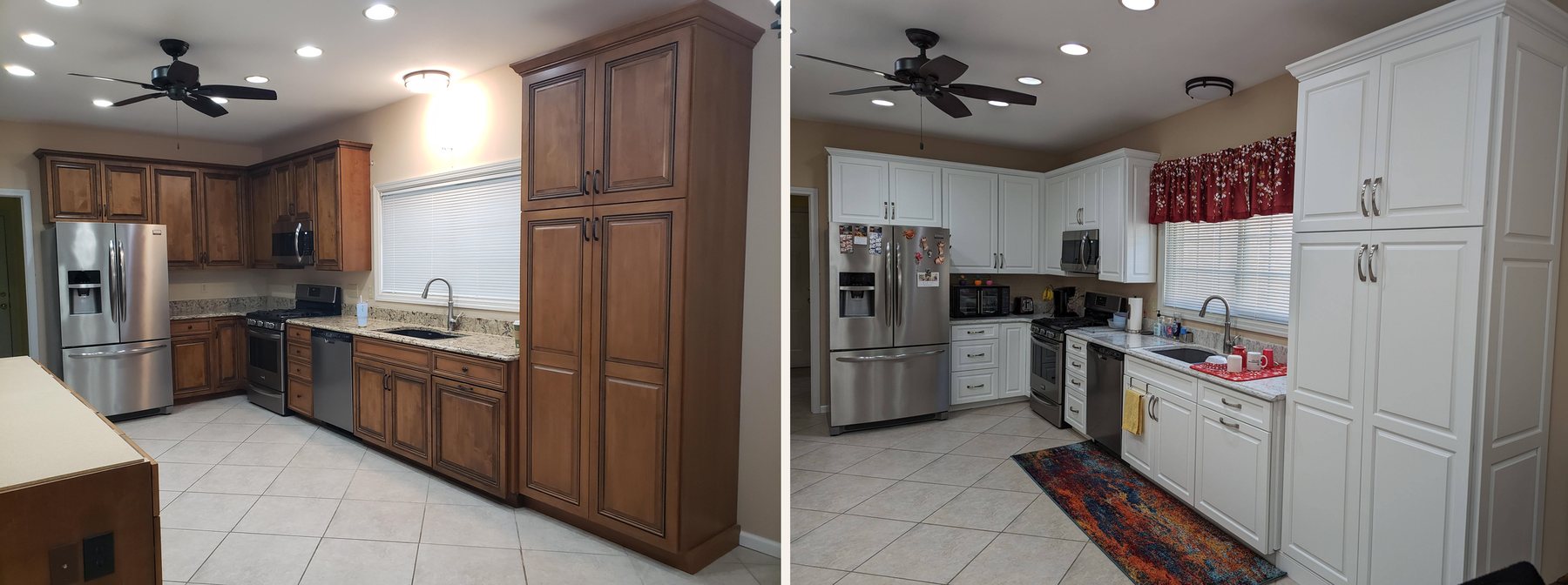
The same kitchen, same footprint, same cabinet boxes. New door and drawer fronts, new hardware and lighting. No walls moved and no cabinetry torn out.
Our working ranges
We price by how much transformation a kitchen actually needs, not by counting doors. Three levels cover almost every project we take on.
| Level | Typical range | Right for you if |
|---|---|---|
| Fresh Faced Refresh | $12,000 to $18,000 | You like your kitchen. You just do not like how it looks. New door and drawer fronts, soft-close concealed hinges, a hardware allowance, minor trim and finish work. |
| Fresh Faced Signature | $15,000 to $30,000 | Most of your kitchen works, but there are several things you would change. Everything in Refresh plus selected new cabinetry, modifications, island work, panels, crown, drawer upgrades and rollouts. |
| Fresh Faced Custom | $25,000 to $50,000+ | You want substantial changes without tearing everything out. Significant new cabinetry, layout modifications, island or pantry redesign, premium storage, countertops, and coordinating the other trades. |
The ranges intentionally overlap, because a larger, simpler kitchen can cost more than a smaller kitchen with more extensive modifications. Size is only one of the drivers.
These are general planning ranges only, not project quotes. Kitchen size, materials, construction requirements, modifications and selected options can all significantly affect the final investment.
One clarification, because you may run into both sets of numbers. Our pricing page lists starting figures by kitchen layout, from $10,416 for a galley or condo kitchen up to $23,281 for an extra-large L with an island. Those are refacing-only starting points: new full-overlay doors and drawer fronts, soft-close hinges, hardware, and cabinet boxes finished to match. The levels in the table above are whole-project numbers, and they carry the function upgrades, replaced cabinets, trim work and countertops that most kitchens end up wanting. Use the pricing page for the floor. Use the table for what you are more likely to actually spend.
The five things that actually move your number
1. How many doors and drawers you have
This is the biggest single driver and the easiest for you to check yourself. Count every cabinet door and every drawer front in the room, including the pantry and any desk or bar area. Our own pricing page is built on this count: a galley or condo kitchen runs about 19 doors and 8 drawers, an extra-large L with an island about 40 doors and 17 drawers. Those are not the same project, no matter how similar the finishes look.
2. What the fronts are made of
Solid wood costs more than a wrapped surface, and it is the single line item we will not compromise on. It is also the difference between a kitchen that still looks intentional in year twelve and one that starts peeling at the dishwasher.
3. How much stays and how much changes
We are not trying to save every cabinet. We are trying to save the right ones. Sound boxes stay and get refaced. A cabinet that is water damaged, an awkward corner, an island that never worked: those get replaced or rebuilt, and each one adds cost. A kitchen where everything stays sits at the bottom of a range. A kitchen with three replaced sections and a reworked island sits at the top.
4. Function upgrades
Deep drawers instead of a base cabinet with a shelf. Rollouts in the pantry. A blind corner that finally gives up its contents. Solid wood dovetail drawer boxes on undermount soft-close glides. None of these are required, and all of them are why people tell us the kitchen feels new rather than just looking new.
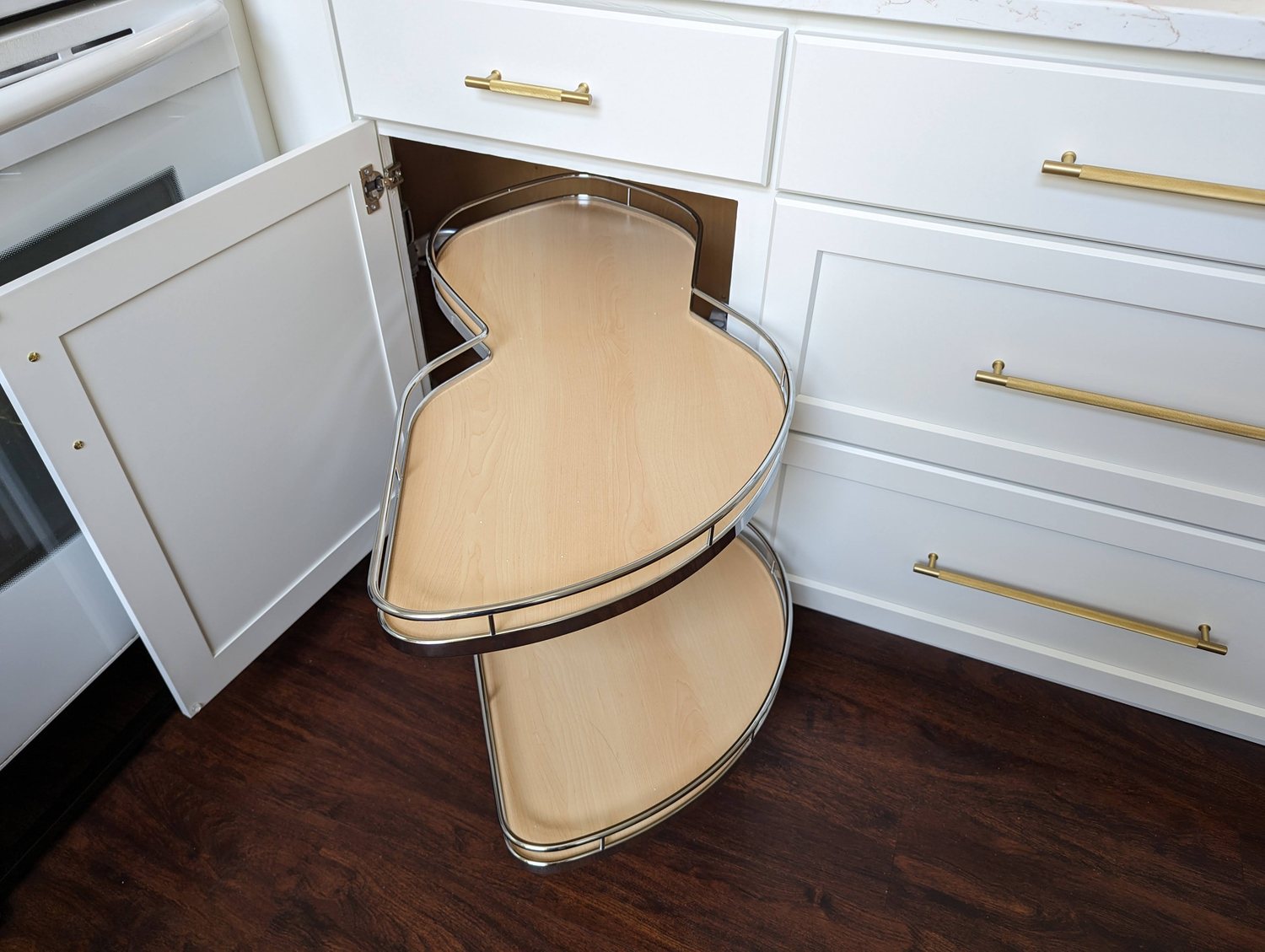
A blind corner is the most wasted cubic footage in a St. Louis kitchen. It is one of the smaller line items on a project this size, and it is the upgrade homeowners mention first when they talk about the finished job.
5. Countertops, trim and the details that read as custom
Crown molding, light rail, decorative end panels on an island, a proper hood surround. This is how builder-grade cabinets stop looking builder-grade. We handle countertops through a partner when a project calls for them. We do not do tile backsplash or flooring, and we will tell you that up front rather than marking up someone else's trade.
What you would spend instead
You can see eighty-odd of these projects, before and after, in our photo gallery. The honest comparison is not refacing against doing nothing. It is refacing against the two other real options.
New cabinets in the same kitchen. You pay for cabinetry, demolition, disposal, often new countertops because the old ones will not survive the removal, plus drywall and paint repair where the old boxes came off. The kitchen is out of service for considerably longer.
A full gut remodel. In the St. Louis market this is a six-figure conversation once layout changes, plumbing, electrical and trades coordination are involved. One local design-build firm publishes $100,000 to $140,000 for a full gut of a small to medium kitchen, with structural changes adding $10,000 to $40,000 on top. For a kitchen whose bones are good, much of that spend is buying you the same result you could have had for less.
We do this in million-dollar homes, and those homeowners are thrilled, and they did not spend six figures on a gut remodel. For around $50,000 you can get something that looks like $100,000, without losing your kitchen for weeks or months.
Dave, owner, Fresh Faced Cabinets
One 2026 wrinkle worth knowing about
Section 232 tariffs on imported kitchen cabinets and vanities took effect on October 14, 2025 at 25 percent. A further increase to 50 percent was scheduled for January 1, 2026, then delayed by proclamation on December 31, 2025. The 25 percent rate holds through 2026 and the increase is now scheduled for January 1, 2027.
Two things follow from that. Imported boxes and doors are already more expensive, and the cheapest end of the new-cabinet market took the hardest hit, because that is where imports concentrate. Cabinets manufactured in the United States carry no Section 232 duty at all, so refacing, which is mostly labor plus domestically made fronts, is the least exposed of the three options on this page. If you were quoted for new cabinets in 2024 and shelved the project, get a fresh number before you assume the old one still applies.
What we will not do on price
You will never get a 40 percent off offer from us, followed by another 15 percent if you sign tonight. Nobody can discount 55 percent off a real price. Companies that run those numbers start from an inflated figure and walk it down until you say yes. We would rather quote the project once, correctly, and add value instead of subtracting price.
How to find out where you land, in about ten minutes
Take four photos with your phone: each wall of cabinets, plus one wide shot of the whole room. Count your doors and drawers. Send them to us and tell us the one thing that bothers you most. We will come back with a ballpark range, not an appointment request.
If the range works for you, we will come out and look properly. If it does not, you have lost ten minutes instead of an evening, and you know something concrete about your kitchen either way. That is a better trade than most of this industry offers.
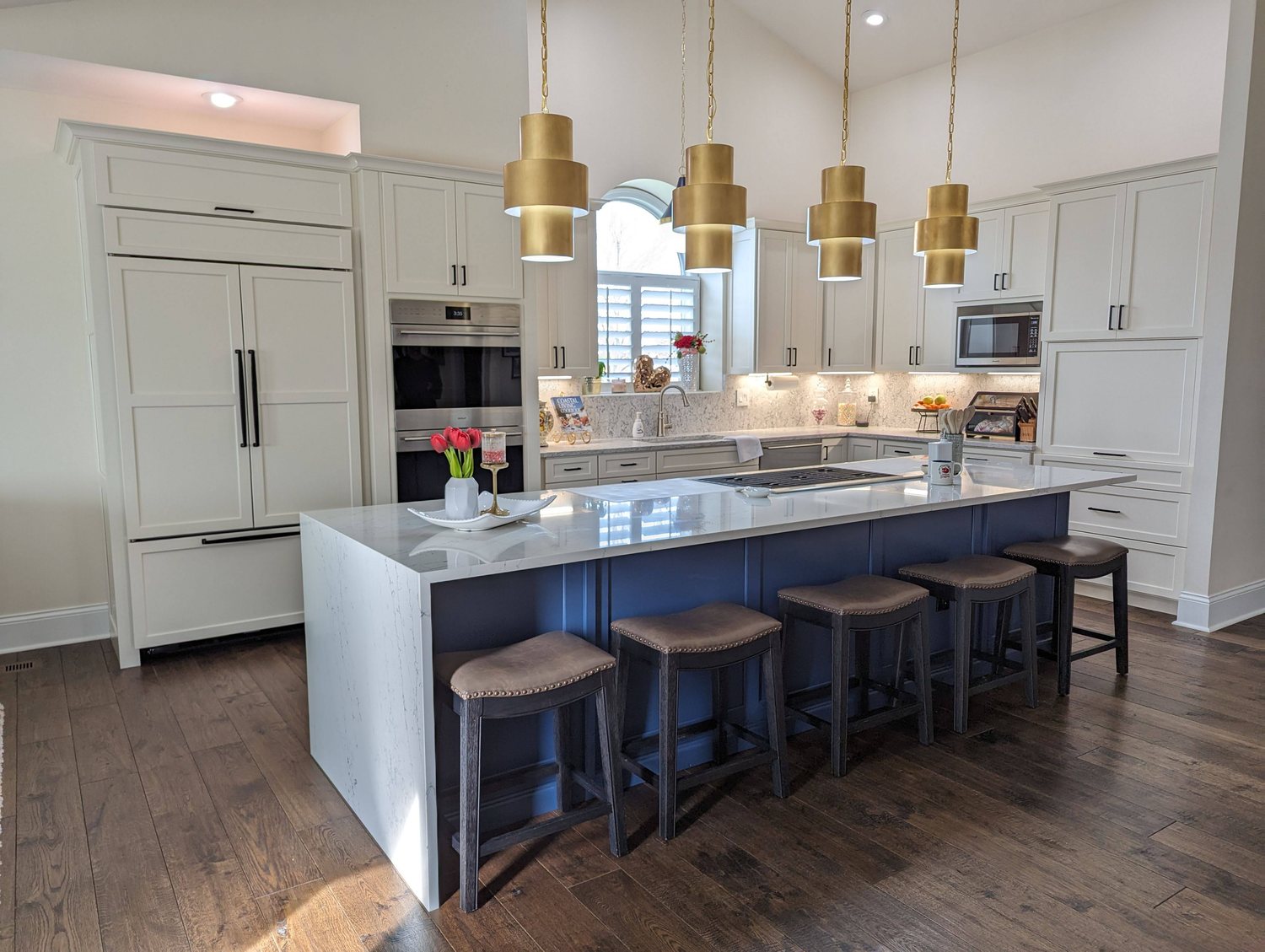
The upper end of a Signature project. New fronts, added trim and a built-up hood surround, all on the original cabinet boxes.
Send us four photos and get a real range
No appointment, no pressure, no sitting through a presentation to learn a number. Text photos to (314) 270-1233 or email refacing@freshfacedcabinets.com and tell us what bothers you most about the kitchen.
Sources
- Fixr, Cabinet Refacing Cost Guide 2026, national averages and per-material cost per linear foot.
- PBS NewsHour, Section 232 tariffs on imported cabinets, vanities and wooden furniture, effective October 14, 2025.
- Thompson Hine SmarTrade, the December 31, 2025 proclamation delaying the increase to 50 percent until January 1, 2027.
- McDermott Remodeling, St. Louis kitchen remodel cost tiers, 2026.
- Fresh Faced Cabinets pricing page, starting figures by kitchen layout.
Dave and Stephanie have been updating St. Louis kitchens for over twenty years, working out of Crestwood and serving St. Louis County and City, St. Charles County, Jefferson County and the Metro East. Solid maple door fronts, our own installation team, and a final walkthrough with an owner on every project.
(314) 270-1233 · refacing@freshfacedcabinets.com · freshfacedcabinets.com