If you live in Chesterfield, Wildwood, Ballwin or west O'Fallon and your kitchen was built in the 1990s, we can probably describe it without seeing it. Honey oak cabinets. Arched top rails on the upper doors. A soffit above them. A small island with an overhang for two stools. Almost certainly a corner sink. We have worked in dozens of them, a lot of which are in our project gallery, and the good news is better than most homeowners expect.
Why so many of these kitchens are identical
Chesterfield incorporated in 1988 and then grew hard. Census figures show the population going from 37,991 in 1990 to 46,802 in 2000, a 23 percent jump in a single decade. That growth was subdivision growth, built fast, by a small number of builders, using whatever the cabinet catalogs offered in that window.
What the catalogs offered was oak. Honey-stained, raised panel, cathedral or arched top doors on the uppers. It was the default from roughly 1988 to 2002 across the whole western corridor of St. Louis County and into St. Charles County. Which means your kitchen is now somewhere between twenty-four and thirty-eight years old, and it is the last thing in the house that has not been touched.
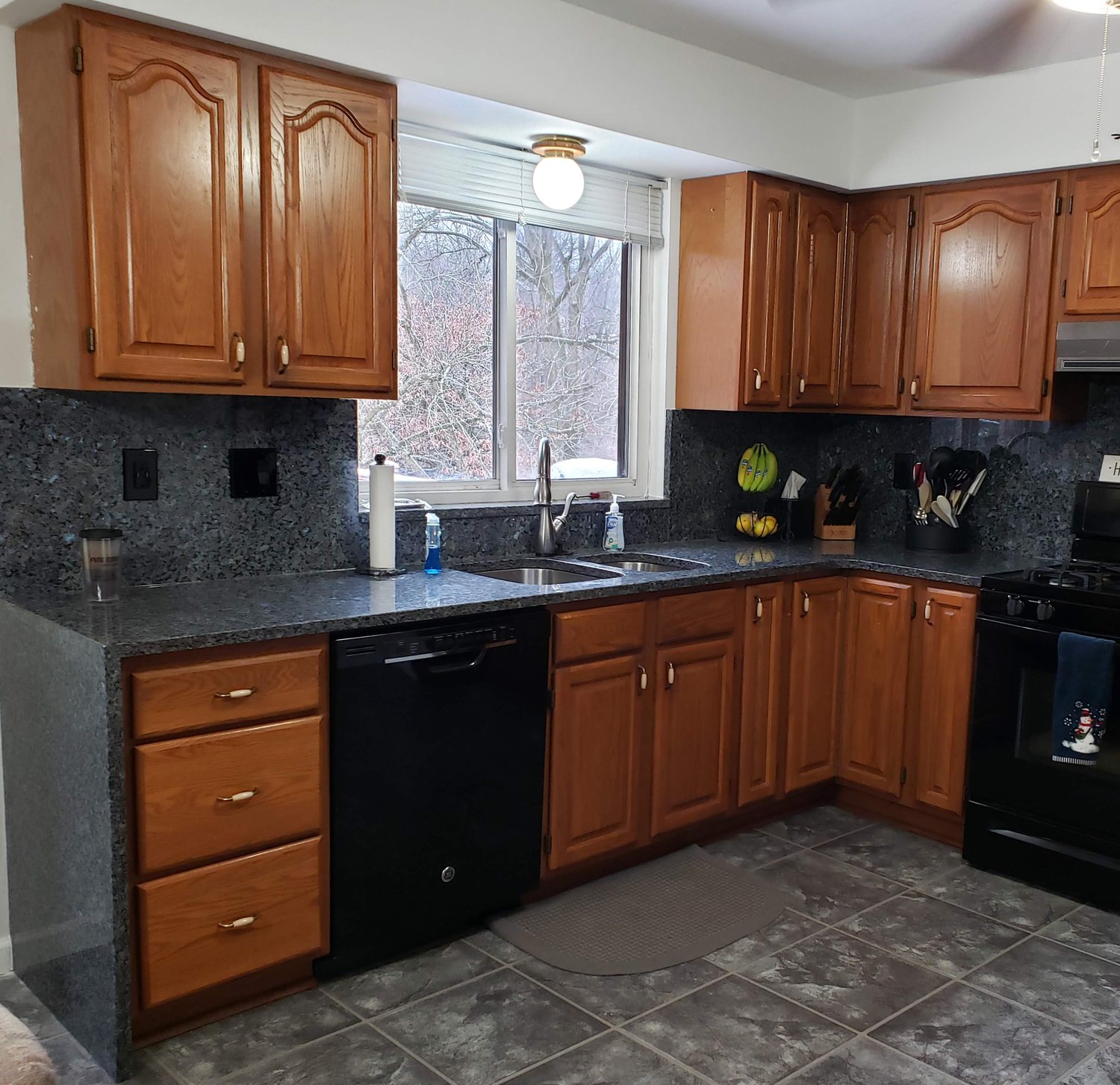
Honey-stained cabinets with wear on the high-touch doors. Typical of what we walk into in a west county kitchen of this era.
The uncomfortable part: oak is coming back, and yours still looks dated
Both of those things are true at once, and it confuses a lot of homeowners.
Warm wood is genuinely returning. Designers are talking about honey oak as a 2026 trend, with Gina Valenti describing it as having "a warmth that aligns perfectly with today's shift toward natural, tactile materials". So why does your kitchen still read as 1996?
Because the wood was never the problem. The same article is specific about it: today's honey tones are "lighter, more matte with less orange overtones," and designer Laurie Coton contrasts them with the heavy vintage look. What dates your kitchen is not oak. It is four other things:
- The orange. The 1990s stain was a heavy amber with a glossy topcoat. Current warm wood is paler and matte.
- The arch. That cathedral top rail is the single most era-specific detail in the room. The same designers advise pairing warm wood with minimalist handles rather than the ornate knobs of the period, and the door profile follows the same logic.
- The soffit. A dropped bulkhead above the uppers, which makes an eight-foot ceiling feel lower than it is.
- The gloss. Sheen dates a kitchen faster than color does.
All four are on the surface. None of them are in the cabinet boxes, which is why this era of kitchen is such a good refacing candidate.
What is worth keeping in a 1990s west county kitchen
More than you would guess.
The boxes. Cabinets from this period are usually plywood or good particleboard with a solid oak face frame, screwed to studs by someone who was building forty houses that year and had the process down. They are square, they are dry, and they will outlast the doors twice over.
The layout. These kitchens were designed after open plan arrived, so the working triangle is usually reasonable and the sink is usually under a window or in the corner with a view. Keeping the layout is what keeps the project out of remodel territory, because the plumbing, the vent route and the electrical all stay where they are.
The island, structurally. Often the top and the overhang are dated rather than the cabinet underneath. New fronts, a panel treatment on the ends and a new surface change the whole room.
Sometimes the granite. A lot of these kitchens got granite in a 2006 update. If you like it, we work around it. Refacing does not require removing countertops, which is one of the larger hidden costs in replacing cabinets.
The three things worth changing
Lose the arch
New door and drawer fronts are where 90 percent of the visual change comes from. A straight top rail on a shaker or slab-adjacent door immediately removes the decade from the room, regardless of whether you go painted or stay in wood.
Decide about the soffit before you start
You have three options and they are very different in cost. Leave it and let the new fronts do the work. Fill the space with a stacked upper cabinet or a trim treatment so it reads as intentional rather than as leftover. Or remove it, which means drywall, possibly relocated wiring or ductwork, and a painter. Most homeowners choose one of the first two once they see the price of the third.
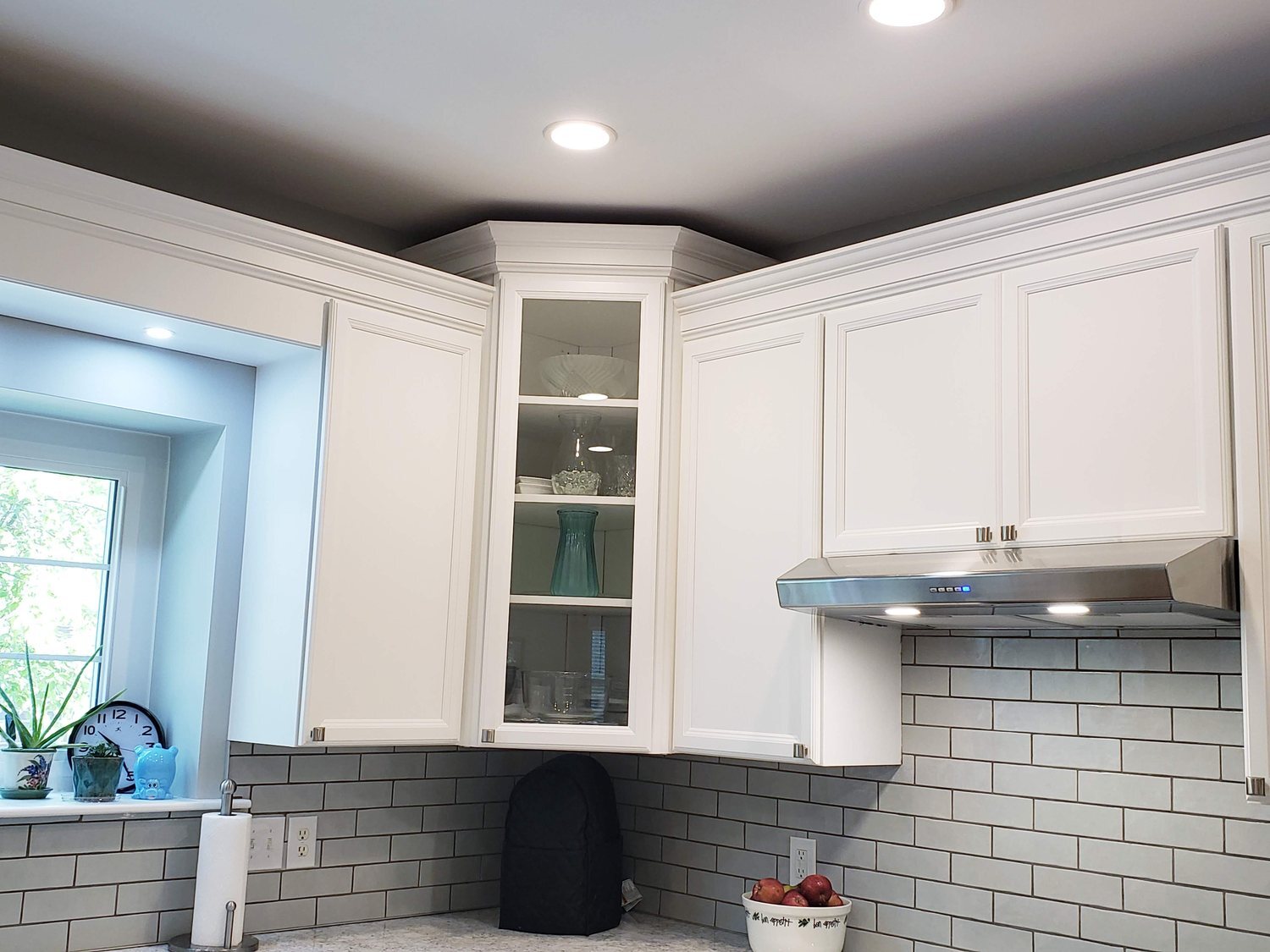
Trim closing the gap above the uppers. The cheapest of the three soffit answers, and in most kitchens it is the one that looks most deliberate.
Fix the two storage problems every one of these kitchens has
The corner cabinet nobody can reach, and the base cabinet with one fixed shelf where everything lives in a pile. Blind corner pull-outs and deep drawers are the upgrades homeowners talk about afterward more than the color.
Two directions that both work
Stay in wood, but current wood. A paler, matte, less orange stain on a straight-rail door. Warm, on trend, and it keeps the character that made you buy a house in a wooded subdivision in the first place.
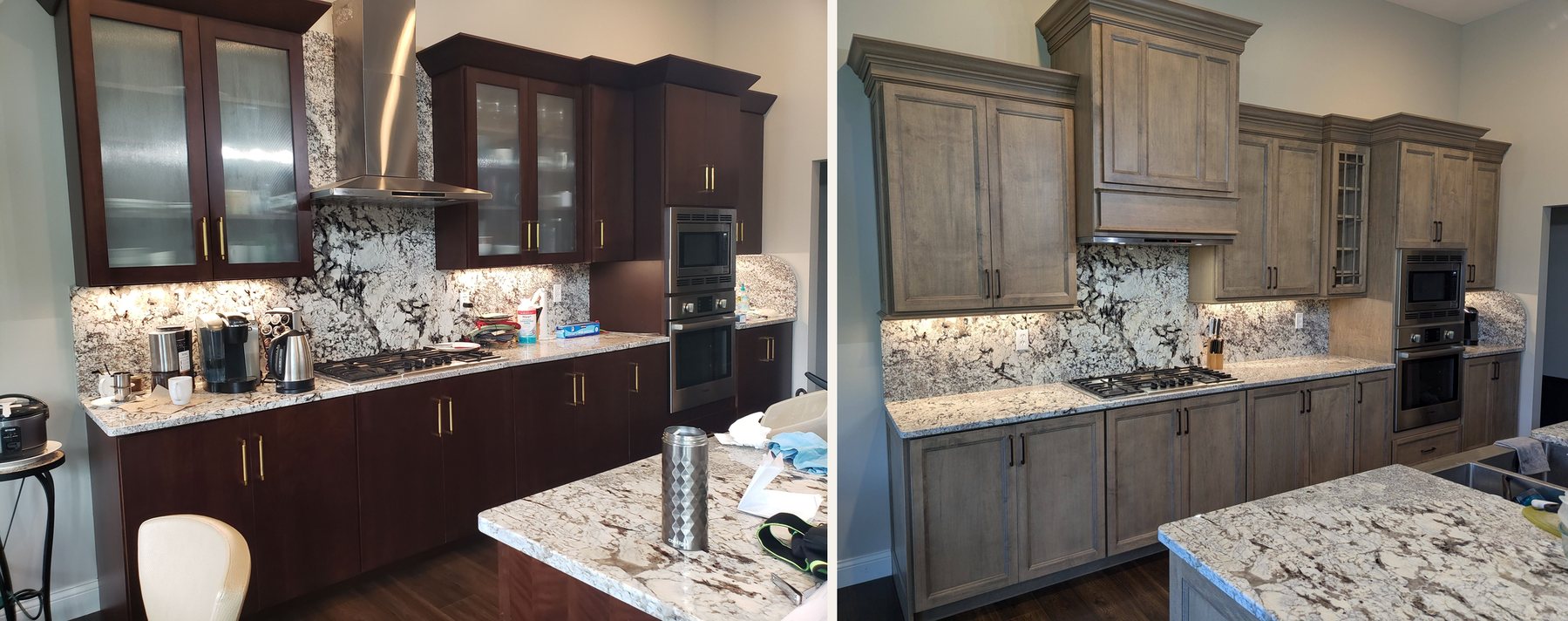
The stay-in-wood direction, in one project. Same cabinet boxes, same footprint, same window and same plumbing. The doors went from a dark, raised, arched panel to a lighter and far less orange straight top rail.
Go painted. Charcoal, navy or a warm off-white on the perimeter, often with a contrasting island. This is the bigger visual change and the most common choice we see in west county.
What this typically costs
A 1990s Chesterfield kitchen of average size, keeping the layout and the countertops, generally lands in our Refresh or Signature range: roughly $12,000 to $18,000 for new fronts, finishes and hardware, and $15,000 to $30,000 once you add function upgrades, trim work and an island treatment. Soffit removal, new countertops or replacing several cabinets push it higher.
General planning ranges only, not project quotes. Kitchen size, materials, construction requirements, modifications and selected options can all significantly affect the final investment.
One timing note
Section 232 tariffs on imported cabinets and vanities took effect on October 14, 2025 at 25 percent, which pushed the cheap end of the new-cabinet market up. The scheduled increase to 50 percent was delayed on December 31, 2025 and is now set for January 1, 2027. Cabinets made in the United States are not subject to the duty at all. None of that is a reason to rush, but it does change the arithmetic of tearing out boxes that are structurally fine, and if you priced a full replacement a couple of years ago and put it off, the comparison is different now than it was then.
We have done a lot of these kitchens
Send four photos, including one of the soffit and one down the length of the uppers, and we will tell you what your specific 1990s kitchen would take. Text (314) 270-1233 or email refacing@freshfacedcabinets.com.
Sources
- Chesterfield, Missouri, incorporation date and decennial census population figures.
- Hunker, Why Honey Oak Cabinets Are Making a Big Return in 2026 Kitchens, designer commentary from Gina Valenti and Laurie Coton.
- Livingetc, on the revival of 1990s honey oak.
- How To Make Oak Kitchen Cabinets Look Modern.
- PBS NewsHour, Section 232 tariffs on imported cabinets and vanities, effective October 14, 2025.
- Thompson Hine SmarTrade, the December 31, 2025 proclamation delaying the increase to 50 percent until January 1, 2027.
Dave and Stephanie have been updating St. Louis kitchens for over twenty years, working out of Crestwood and serving St. Louis County and City, St. Charles County, Jefferson County and the Metro East. Solid maple door fronts, our own installation team, and a final walkthrough with an owner on every project.
(314) 270-1233 · refacing@freshfacedcabinets.com · freshfacedcabinets.com