When most homeowners hear the word refacing, they picture something being glued over their old doors. A skin. A cover-up. Lipstick on a pig. That picture is not imaginary, because somebody really is selling that, and it is the cheapest thing in the category. It is also not what we do, and the difference is not a matter of taste. It shows up in year eight, at the dishwasher, in a way that cannot be repaired.
Three different products, one word
"Cabinet refacing" describes at least three products that have very little in common beyond keeping your cabinet boxes.
1. Rigid thermofoil and vinyl wrap
A sheet of vinyl film is heat-pressed onto an MDF door blank. It is fast to make, cheap to ship, and available in a limited set of colors. National cost data puts laminate refacing at $80 to $125 per linear foot, and thermofoil sits in the same band. That is the bottom of the market.
2. Veneer over frames with builder-tier doors
A wood or laminate veneer is applied to the face frames, and new doors are ordered from whoever is cheapest that month. Better than option one. Wildly inconsistent, because the door quality is invisible in a brochure.
3. New solid wood fronts, with the frames finished to match
The doors and drawer fronts are new, made to order, and built the way a good new cabinet is built. The existing face frames are either painted on site to match the factory finish, or veneered in real wood to match the new door style. Solid wood work sits at the top of that same cost range, $200 to $500 per linear foot. This is what we do, and we do not offer the other two.
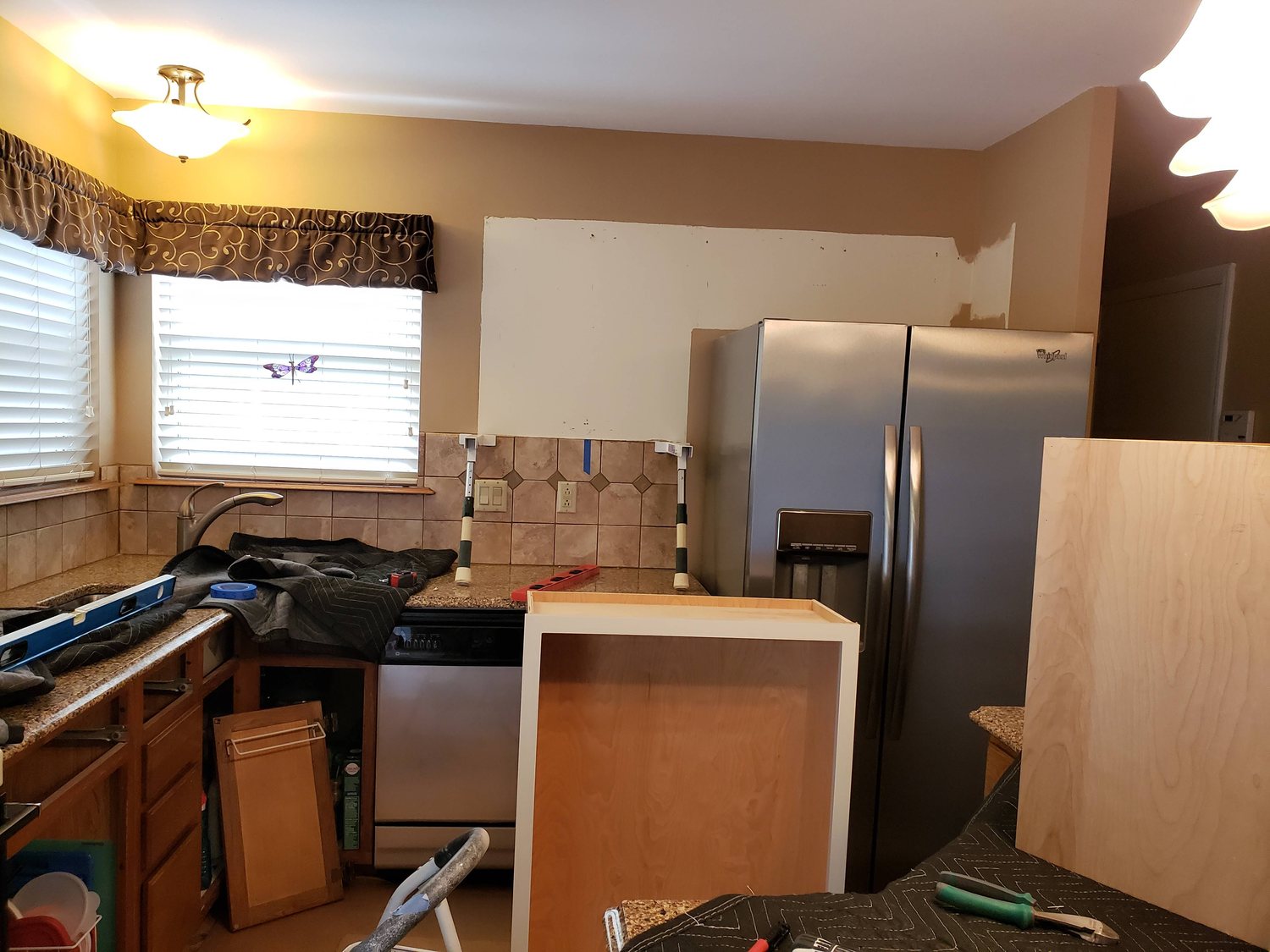
Mid-project. The old fronts are off, and the sound boxes are staying. This is the part of refacing nobody photographs, and it is where you can actually see what a company is doing.
What goes wrong with thermofoil, specifically
This is not a matter of opinion or brand loyalty. The failure modes are documented by the cabinetmakers who sell the stuff.
- Heat and steam separate it from the door. Cabinet manufacturer Deslaurier notes that thermofoil exposed to pronounced steam or high heat can melt, peel or blister, and that the film separates from the substrate underneath. The two places that happens first are the cabinet next to the oven and the one beside the dishwasher, which is to say the two doors you look at most.
- It effectively cannot be repaired. Because the film is heat-wrapped in a factory press, there is no practical way to reattach a lifted edge on site. Deslaurier's own wording is that it is "nearly impossible to repair thermofoil doors without replacing them." If the color has been discontinued, that means a mismatched door or a whole new set.
- Scratches let water into the core. The film is water resistant. The MDF blank underneath is not. A scratch near a sink is a slow leak into the door itself.
- The color moves. Whites and off-whites can yellow. Darker colors fade, particularly on a sunny wall, and a St. Louis kitchen with a west-facing window gets plenty of that.
- Shorter life. Deslaurier puts thermofoil at ten to fifteen years with good care, and backs it with a ten year warranty against twenty years for painted MDF and natural wood.
Ten to fifteen years sounds like a long time when you are signing. It is not, when the reason you are calling us in the first place is that your current cabinets are twenty-five years old and the boxes are still perfectly sound.
Why our painted doors have an MDF center panel
Here is a detail that sounds like a downgrade until you understand it, and it is the fastest way to tell whether the person quoting your kitchen actually knows cabinetry.
Our doors are solid wood maple. On painted doors, the center panel is MDF rather than solid wood. That is deliberate, and it is the more expensive choice, not the cheaper one.
Solid wood moves with the seasons. It swells in a humid St. Louis July and shrinks in a dry January. On a stained door that movement is invisible, because the panel floats in the frame and any shift just shows more of the same wood. On a painted door it is very visible. The panel shrinks, the paint line at the edge of the panel cracks, and you get a thin unpainted witness line all the way around every center panel in the kitchen. It looks like a defect. It is just physics.
MDF does not move that way. On a painted door it holds a dead-flat, seamless finish for the life of the door. The frame and the stiles are still solid maple, doing the structural work. Anybody selling you a fully solid painted door either has not seen one after five Missouri winters, or is hoping you have not.
The quality of the materials we use for kitchens would be in the upper level of cabinet. If you go to buy a new cabinet, it's not like going to Home Depot. It's a better quality.
Dave, owner, Fresh Faced Cabinets
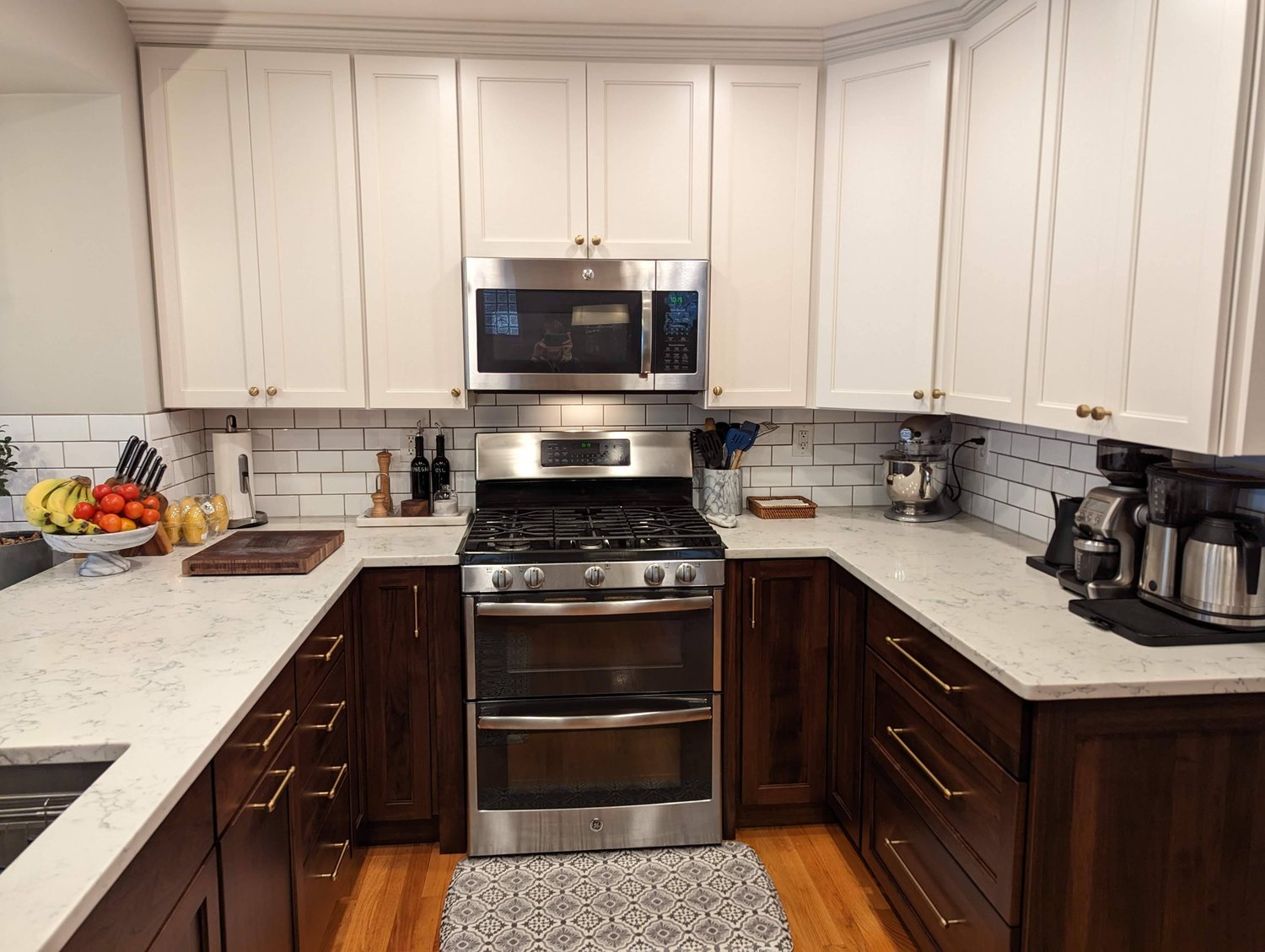
New solid wood fronts on original boxes. The grain, the edge profile and the way the doors sit in relation to each other are all things you can inspect before you commit.
Five questions that separate the three products
- What is the door made of, layer by layer? You want to hear a species name. "Solid maple, MDF center on painted" is an answer. "Premium engineered surface" is a description of vinyl.
- Are the doors made to order, or pulled from stock? Made to order means the door is built to your kitchen's sizes, species and finish by a cabinet door manufacturer. Stock means a warehouse of pre-made sizes in a handful of colors, and it is why some quotes come with a very short list of options. Ask where the doors are manufactured, too.
- What happens to my face frames and cabinet boxes? Painted on site to match, or veneered in real wood, are both legitimate. "We cover them" is worth a follow-up question about what the covering is.
- Are you painting the doors, or are the doors coming finished? Doors sprayed in a house never match a factory finish for durability. We replace the doors rather than paint them, and we finish only the boxes and frames, in the home, to match.
- What is covered, and on which part? Ask about the door, the finish and the installation separately, rather than accepting one number for the whole job. Manufacturers publish very different terms by material, and as the Deslaurier figures above show, that is where a ten year product gets quietly separated from a twenty year one.
How to inspect a door sample in your own hands
- Look at the edge. Real wood has continuous grain running off the edge. A wrapped door shows a seam or a rolled edge where the film terminates.
- Weigh it. A solid maple door has real heft. A vinyl-on-MDF blank of the same size feels light and dead.
- Turn it over. On a wrapped door the back is usually a different, cheaper laminate. On a good door the back is finished wood.
- Press the center panel. On a five-piece door you should feel a distinct frame around a panel. A one-piece routed slab with no real joinery is a wrapped door.
Why this matters more than the price difference
The cheapest version of refacing exists because it lets a company advertise a low number. It delivers exactly what people fear about the whole category, which then gets blamed on refacing generally rather than on the material. That is the reason we spend so much of a consultation talking about construction instead of colors.
We are not the cheap alternative to a remodel. We are the alternative that keeps the sound cabinetry you already paid for and puts genuinely good doors on it. If you want the number for that, send us four photos of your kitchen and we will give you a range before you ever book an appointment.
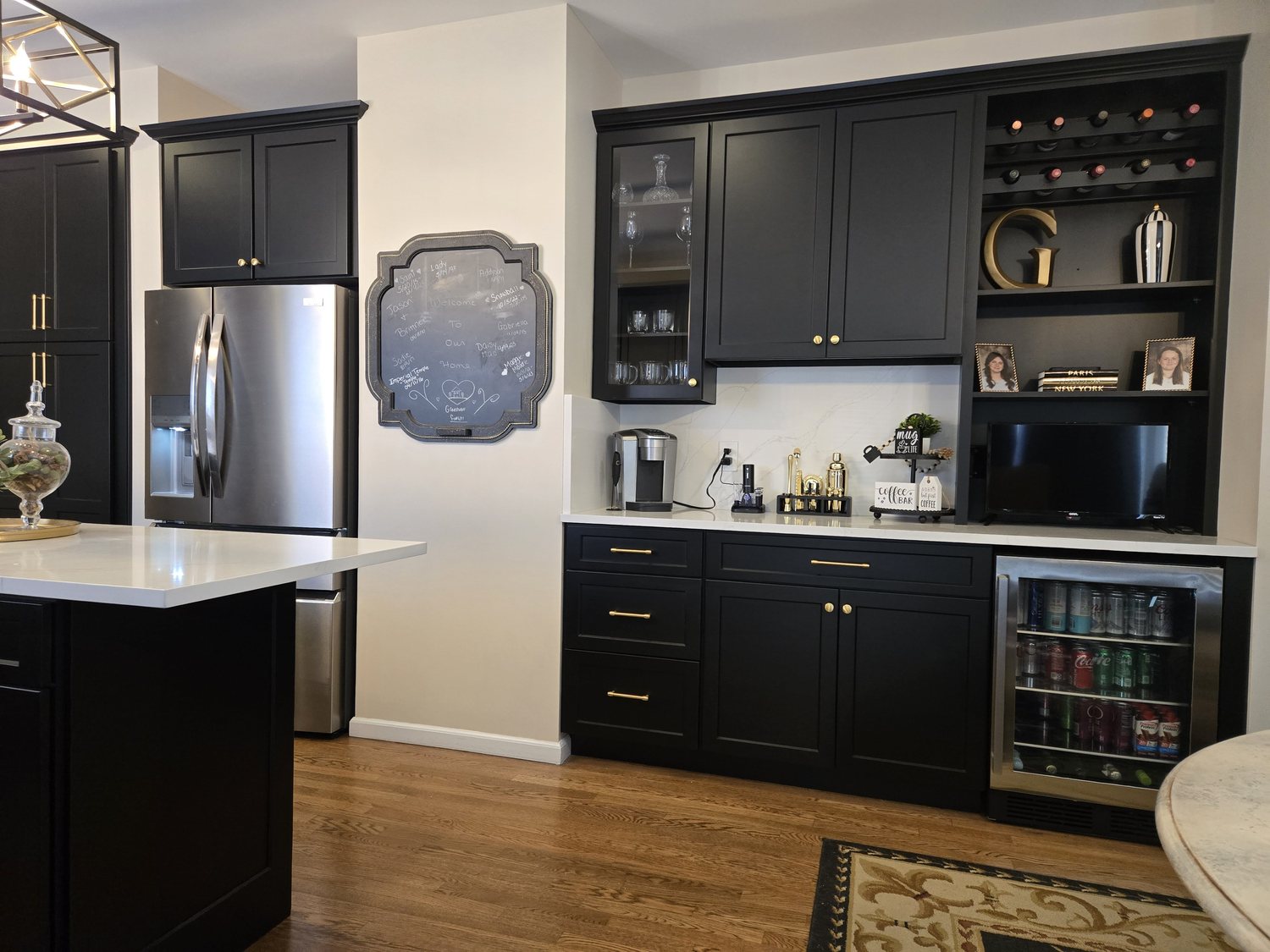
A finished painted project. Flat, seamless center panels with no witness lines, because the panel is not going to move on you in February.
Ask us the five questions
We would rather you interrogated our materials than took our word for them. Call or text (314) 270-1233, or email refacing@freshfacedcabinets.com, and we will bring samples you can put your hands on.
Sources
- Deslaurier Custom Cabinets, Six Problems with Thermofoil Kitchen Cabinets, heat delamination, repairability, color change, and stated ten year versus twenty year warranties.
- Fixr, Cabinet Refacing Cost Guide 2026, cost per linear foot by material.
- Refaceful, The Downsides of Rigid Thermofoil Cabinets.
- Refacing Thermofoil Kitchen Cabinets: Fix Peeling Doors.
Dave and Stephanie have been updating St. Louis kitchens for over twenty years, working out of Crestwood and serving St. Louis County and City, St. Charles County, Jefferson County and the Metro East. Solid maple door fronts, our own installation team, and a final walkthrough with an owner on every project.
(314) 270-1233 · refacing@freshfacedcabinets.com · freshfacedcabinets.com