If you have priced new kitchen cabinets this year, you may have already run into it. Imported kitchen cabinets have carried a 25% federal tariff since October 2025, and on January 1, 2027 that rate is scheduled to double to 50%. Here is what is actually changing, who it touches, and what it means if you are deciding between new cabinets and keeping the ones you have.
What is actually happening
In late September 2025, a presidential proclamation under Section 232 of the Trade Expansion Act put a 25% duty on imported kitchen cabinets and bathroom vanities. It took effect on October 14, 2025, and it covers finished cabinets and their parts, whether they arrive assembled or flat-packed.
The same order scheduled the rate to rise to 50% on January 1, 2026. On December 31, 2025, that increase was pushed back one year, to January 1, 2027. As of this writing, that is still the date.
A few details that matter if you are reading a quote:
- Cabinets from the United Kingdom are capped at 10%, and cabinets from the European Union and Japan at 15%.
- Cabinets from China already carried separate antidumping and countervailing duties dating back to 2020, on top of this one.
- The date has moved once already. It could move again in either direction. We will update this post if it does.
Who it actually touches
The tariff applies to cabinets and cabinet parts made outside the United States. Plenty of stock and ready-to-assemble lines, especially at the budget end, are imported. Plenty of other cabinets are built here and are not subject to this duty at all.
So the honest answer to "are cabinet prices going up?" is: it depends entirely on where the cabinets in your quote are made. A new kitchen built from imported boxes is the purchase most exposed to January 1. A kitchen built from domestic boxes is not, although domestic makers have their own material and labor costs, and those move for their own reasons.
The trouble is that most quotes do not say where anything is made. That is the first question worth asking, and it is in the list below.
What refacing keeps out of the equation
When we reface a kitchen, the cabinet boxes stay on the wall. The sides, backs, bottoms, shelves and face frames that are already in your house are not bought again, shipped again or imported again. We replace the doors and drawer fronts, then finish the frames and exposed sides to match, so the whole kitchen reads as new.
The box is most of a cabinet. It is also the part you never really look at. Keeping it, when it is sound, is what makes cabinet refacing a different purchase from new cabinets, tariff or no tariff.
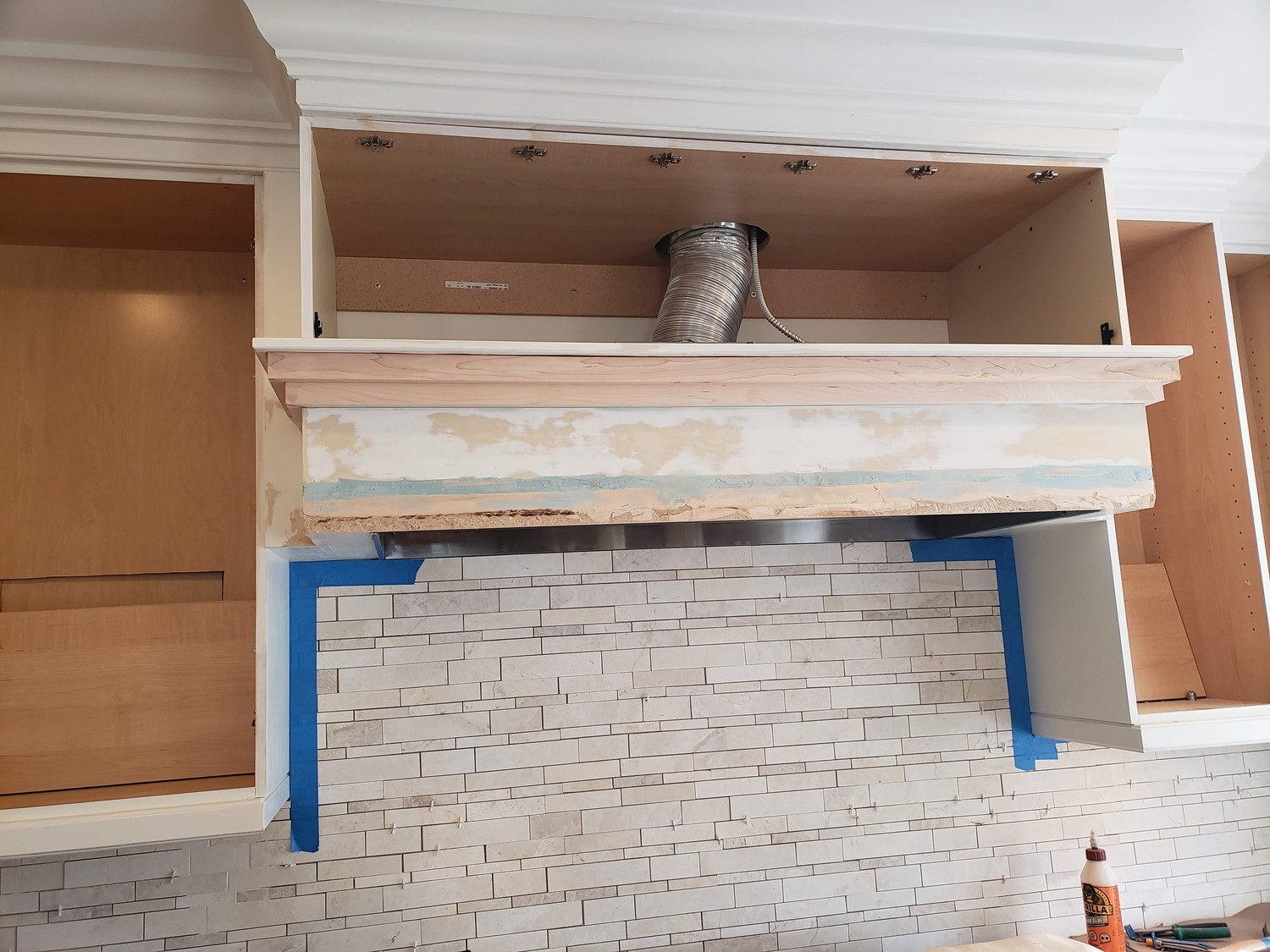
Mid-job. The doors are off and the original boxes are still on the wall. Nothing behind the face of these cabinets was torn out, shipped in or bought twice.
And the doors? Ours are made in the U.S.A., so a duty on imported cabinet parts does not apply to them. The door is the part of the kitchen you touch and look at every day, and it is the part of the job we are least willing to compromise on.
To be straight with you: a tariff is one cost among many. Wood, finishes, hardware and labor all change in price for reasons that have nothing to do with trade policy, and we are not going to promise that nothing we buy ever goes up. What we can say is that this particular duty is aimed at imported cabinets and cabinet parts, and refacing with American-made doors on the boxes you already own sits largely outside it.
What the tariff does not change
It does not make a failing cabinet worth keeping. If the boxes under your sink are water damaged, if the particleboard is swelling, if shelves sag or boxes have pulled out of square, new doors on them is money spent twice. A tariff on new cabinets does not change that, and we will tell you so when we see it. Sometimes the right answer is to replace only the cabinets that are failing and reface the rest.
It is also not a reason to rush. If you were already planning a kitchen for 2027 and imported new cabinets are the plan, when they are ordered and delivered may matter, and that is a conversation to have with your supplier now. If you were not planning a kitchen at all, a change in import duties is not a reason to start one.
Five questions to ask any cabinet quote right now
Whatever you are pricing, from whoever, these will tell you how exposed your project is to January 1.
1. Where are the boxes and the doors made?
Ask for both, separately. A cabinet can be assembled in one country from parts made in another. If the seller does not know, that is useful information too.
2. Is the current tariff already in this price?
If the cabinets are imported, the 25% duty is being paid by someone. Ask whether it is built into the number in front of you or added later.
3. What happens if delivery lands after January 1?
This is the one that catches people. A quote signed in December for cabinets that arrive in February may be exposed to the higher rate. Ask whether your price is locked, and get the answer in writing.
4. Can a tariff surcharge be added after I sign?
Some contracts allow it. Read that section before you sign, not after the invoice arrives.
5. What would it cost to keep the boxes I have?
Even if you are leaning toward new, it is worth knowing the alternative. Our published prices by kitchen layout are a starting point, and we wrote a full guide to what cabinet refacing actually costs in St. Louis.
The one question that does most of the work
"If the duty doubles before my cabinets ship, who pays the difference?" A seller with a clear, written answer has thought about it. A seller who changes the subject is telling you who pays.

The same wall, finished. Same boxes, same layout. New doors and a new hood surround, and the cabinets that were sound stayed where they were.
Where this leaves you
If your cabinet boxes are sound, the January tariff increase is one more reason to look hard at keeping them. If they are not, it is a reason to ask better questions about where the new ones come from and when they will arrive. Either way, the goal is the same one it was before any of this: spend the money on the parts of the kitchen you will actually see and use for the next twenty years.
If you are not sure which side of that line your kitchen is on, that is the easiest thing for us to answer.
Find out if your boxes are worth keeping
Four photos of your kitchen, and any quote you are already holding. Text (314) 270-1233 or email refacing@freshfacedcabinets.com. We will tell you whether refacing makes sense, and say so plainly if it does not.
Sources
- Thompson Hine SmarTrade, "President Trump Delays Section 232 Tariff Increase on Wood Furniture, Cabinets and Vanities", January 2026.
- GHY International, U.S. tariffs on kitchen cabinets and vanities, rates, country caps and parts coverage.
- TC Wholesale Cabinetry, "Cabinet Tariffs 2026 to 2027", Proclamations 10976 and 11000 and the China duties.
- TheStreet, "The factories meant to absorb your kitchen tariff are shrinking", September 2026.
- Fresh Faced Cabinets, American-made doors.
Dave and Stephanie have been updating St. Louis kitchens for over twenty years, working out of Crestwood and serving St. Louis County and City, St. Charles County, Jefferson County and the Metro East. Solid maple door fronts, our own installation team, and a final walkthrough with an owner on every project.
(314) 270-1233 · refacing@freshfacedcabinets.com · freshfacedcabinets.com